
SFDA Medical Device Registration (MDMA): A Complete Guide for Foreign Manufacturers
Saudi Arabia has become one of the most attractive medical device markets in the Middle East, driven by a rapidly expanding healthcare sector and the ambitious goals of Vision 2030. But market access is tightly regulated — and the gateway is the Medical Device Marketing Authorization (MDMA), administered by the Saudi Food and Drug Authority (SFDA).
For foreign manufacturers, MDMA registration can feel complex. This guide breaks it down into a clear, practical roadmap — from understanding device classification to receiving your marketing authorization.
What is MDMA registration?
The Medical Device Marketing Authorization (MDMA) is the official SFDA licence that permits a medical device to be legally imported, distributed, and sold in Saudi Arabia. No device may enter the Saudi market — regardless of CE marking, FDA clearance, or ISO certification — without a valid MDMA.
MDMA is not a one-time formality. It must be maintained, renewed, and updated whenever the device undergoes significant changes. Treating it as a living regulatory asset is key to sustained market access.
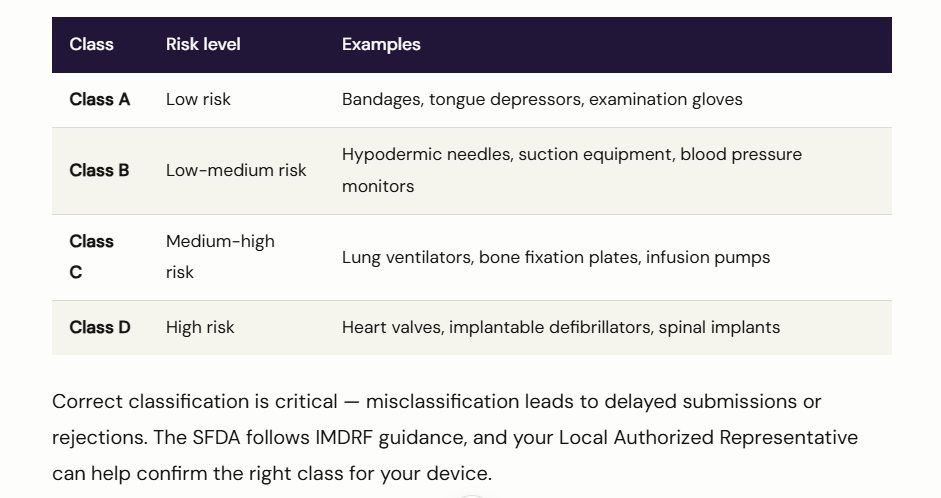
The SFDA classifies medical devices into four risk-based classes. Your class determines the level of technical evidence required and the registration pathway:
Step 2: Appoint a licensed Local Authorized Representative
Before submitting any application, you must appoint a Saudi-registered and SFDA-licensed Local Authorized Representative (LAR). The LAR acts as your regulatory proxy in the Kingdom — they submit on your behalf, manage SFDA communications, and take regulatory responsibility for your device in the Saudi market. Without an active LAR, your application cannot proceed.
Step 3: Prepare your technical file
The technical file is the backbone of your MDMA submission. Its required contents vary by device class, but generally include:
- Device description and classification justification
Clear identification of the device, its intended purpose, and the rationale for its risk class assignment. - Labelling and instructions for use
All labelling must comply with SFDA requirements, including Arabic language provisions where required. - Clinical evidence
Clinical data demonstrating safety and performance — clinical evaluations, literature reviews, or clinical investigations aligned with IMDRF guidelines. - Quality management system certification
ISO 13485 certification is required, along with evidence of conformity to applicable standards (CE, FDA 510(k), or equivalent). - Post-market surveillance plan
A documented plan for monitoring device performance once on the market, including vigilance reporting procedures. - Risk management documentation
A risk management file aligned with ISO, demonstrating that risks have been identified, evaluated, and mitigated.
Step 4: Submit via the GHAD portal
All MDMA applications are submitted electronically through the SFDA's GHAD platform. Your LAR creates and manages the submission account and uploads the technical file on your behalf. Completeness and accuracy at this stage are critical — incomplete submissions are returned and restart the review clock.
Step 5: SFDA technical review and queries
Once submitted, the SFDA conducts a technical review of your file. The timeline varies by device class — Class A devices are generally faster, while Class C and D devices undergo more rigorous evaluation. During the review, the SFDA may raise technical queries (deficiency letters) requesting additional information or clarification.
Prompt, accurate responses to SFDA queries are essential. Delayed or insufficient responses stall the review and can lead to application withdrawal. Having an experienced LAR manage this process significantly reduces resolution time.
Step 6: Marketing authorization issued
Upon successful review, the SFDA issues the MDMA certificate — your device's legal passport into the Saudi market. The authorization is typically valid for five years and must be renewed before expiry. Any changes to the device, its labelling, or its manufacturer during this period must be notified to or approved by the SFDA.
Common reasons for rejection
Understanding why applications fail helps you avoid the same pitfalls. The most frequent causes of MDMA rejections include: incorrect device classification, incomplete or poorly structured technical file, missing or non-compliant Arabic labelling, inadequate clinical evidence for the device's risk class, and failure to appoint a licensed LAR before submission.
At M A Innovation, we guide foreign medical device manufacturers through every stage of SFDA MDMA registration — from classification and file preparation to SFDA query management and post-authorization maintenance. As a licensed LAR, we are your single point of contact for full Saudi market compliance.